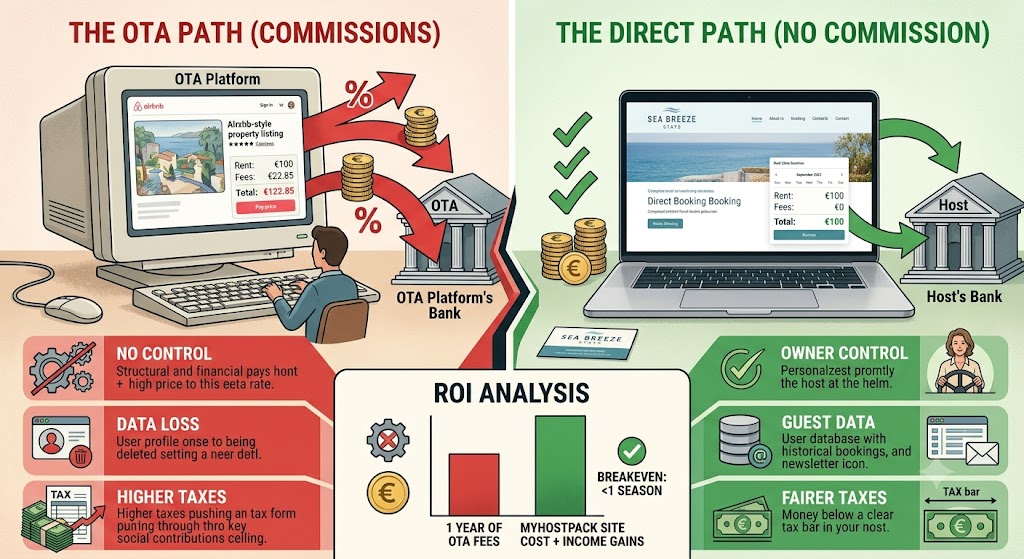
You know the exact amount that platforms deducted from your bookings last year?
Note: This article was written based on the French tax and legal framework, but its core strategic insights remain highly valuable and relevant regardless of your country's specific tax regulations.
Most hosts reply with a vague estimate — "15%, something like that." And almost none of them measure what these commissions cost them beyond the money: lost guests who slip through their fingers, and a business where they no longer set the rules. This is precisely what this article will quantify.
Executive Summary
Airbnb and Booking.com commissions don’t just erode your profit margins: a host managing 30 bookings a year already loses over €1,500 to €2,000 per year in raw commissions alone. But that number only tells a fraction of the story. The true cost is also strategic: these commission-inflated prices are passed on to your guests, who then actively look to book cheaper elsewhere. It is also structural: you control neither your rates, your policies, nor your customer relationships. Everything belongs to the platform and can change overnight — as proven by the brutal Airbnb commission hike on October 13, 2026. A direct booking website at €570 covers its cost in less than a single season — but its real return on investment lies elsewhere: bookings won over competitors who don't have a website, and the freedom to stop enduring a third party's rules.
1. The Triple Cost of Platforms: Financial, Commercial, and Structural
When you ask a host how much Airbnb and Booking.com cost them, the spontaneous answer almost always revolves around money: "15%, 18%, just another fee." That is true, but highly incomplete. In reality, these platforms cost you on three entirely different levels, and only the first one is visible on an account statement:
- The Direct Financial Cost: The commission deducted from every single booking.
- The Commercial Cost: The resulting inflated price pushes a segment of your guests to look for a cheaper alternative, including trying to book you directly.
- The Structural Cost: You own neither your rates, the rules of the game, nor the direct contact with your own guests — a major risk for the sustainability of your business, as all of this can change without your consent.
Let’s break down these three costs with up-to-date figures.
2. The Financial Cost: What Commissions Take From You Every Year
Let’s look at a representative case for an accommodation in France (Average Daily Rate of €120, average stay of 3 nights, meaning an average booking value of €360), with 30 bookings per year.
| Platform | Commission Rate | Annual Cost (30 bookings) |
|---|---|---|
| Airbnb (since 10/13/2026) | 15.5% excl. VAT, meaning 18.6% incl. VAT with VAT on commission | ≈ €2,009 |
| Booking.com | 15% to 18% | €1,620 to €1,944 |
The detail that changes everything for Airbnb: the net price means nothing to most hosts. The Airbnb commission is subject to a 20% VAT (15.5% × 1.20 = 18.6% incl. VAT). However, the vast majority of independent individual hosts operate under the micro-BIC tax regime and fall under the VAT exemption threshold: they can never reclaim this VAT. Therefore, the rate to use in your calculations is not 15.5%, but indeed 18.6%, representing a pure net loss.
On this basis alone, a host with 30 bookings loses between €1,600 and €2,000 per year. A property manager managing 3 properties in the same scenario loses between €5,000 and €6,000 per year purely in commissions — an amount that scales up ruthlessly with volume.
3. The Commercial Cost: Your Guests Pay the Price of This Commission, and They Know It
This is the point most frequently overlooked: this commission does not stay hidden between you and the platform. It directly impacts the final price paid by the traveler via two compounding mechanisms:
- Guest service fees, added to the displayed price (14% to 20% depending on the platform);
- Your own pricing, which you must inflate to absorb the host commission and maintain the same net income (to pocket €100 net on Airbnb since October 2026, you must list your property at €122.85, not €118.60 — because the commission is calculated on the final retail price, not your starting payout target).
As a result, the traveler sees a significantly higher total price than what you actually receive. This inflated price triggers a highly predictable user behavior: once a guest has spotted your property on a platform, it becomes entirely rational for them to search for a cheaper way to book it elsewhere, typing the name of your property or your business directly into Google. This cost-saving reflex is incredibly widespread, especially among returning guests.
If you do not have a website at that exact moment, you lose that high-intent search: the guest either books with a competitor who offers a direct channel, gives up entirely, or books through the platform anyway while resenting the premium price tag — which hurts your perceived competitiveness.
4. The Structural Cost: You Control Neither Your Rates, the Rules, Nor Your Customer Relationships
This is the hardest cost to quantify, yet it is the most critical for the long-term survival of your business: as long as nearly 100% of your bookings flow through a platform, you master none of the variables that dictate your revenue.
- The commission rate can change without long notice or negotiation. The recent Airbnb shift, forcing its host commission from 3% up to 15.5% excl. VAT (18.6% incl. VAT) on October 13, 2026, is the most recent and brutal demonstration of this reality. Nothing prevents Booking.com, or Airbnb again, from raising their rates at the expense of hosts in the future.
- Search ranking algorithms, display rules, and cancellation policies are decided unilaterally by the platform, and can tank your visibility overnight.
- You do not own the customer relationship. Contact details, booking history, the ability to re-engage a loyal guest: everything belongs to the platform, not you. The day a guest can no longer find your listing (due to an algorithmic shift, account suspension, or a platform dispute), you lose a customer you thought was yours, with zero means to contact them.
This absolute dependency, far more than the commission amount itself, leaves your business exposed: a business model that relies 100% on rules written by a third party is never truly yours.
5. The Indirect Tax Cost: How Artificially Inflating Your Prices Pushes You Into Social Security Contributions
This strategy of inflating prices to absorb platform commissions (point 3) has an unexpected tax consequence. The higher price you list constitutes your declared gross revenue, even though a large chunk of it immediately leaves your hands as a platform fee.
In France, a non-professional furnished lessor (LMNP) remains under the standard tax framework as long as their total annual revenue stays below or equal to €23,000 for the household. Beyond this threshold, the activity automatically shifts into the compulsory payment of social security contributions, a far more financially restrictive and demanding regime.
Crucially, this threshold is assessed on gross revenue collected — the exact figures that platform commissions force you to artificially inflate. A host sitting close to the limit can find themselves pushed into the social security contribution brackets prematurely, not because their business actually grew, but simply because their prices had to rise to digest a massive commission hike. Commissions don't just shrink your margins; they can also accelerate your transition into a much more punitive tax and social framework without generating a single extra euro for you.
6. The Micro-BIC Tax Allowance: A Frequently Overlooked Leverage Point
Once your revenues are declared under the French micro-BIC regime, you receive a flat-rate deduction for expenses before income tax is calculated. This rate depends entirely on the official classification of your property:
- Unclassified Furnished Holiday Rental: A 30% tax allowance, applicable up to €15,000 in annual revenue.
- Classified Meublé de Tourisme (or Bed & Breakfast): A 50% tax allowance, applicable up to €83,600 in annual revenue in 2026.
Getting your property officially classified (a straightforward process via an accredited body) instantly doubles your tax deduction and significantly raises your revenue ceilings before you are forced into actual-expense accounting (Régime Réel). This is a powerful lever that directly improves your net take-home pay, completely independent of OTA algorithms.
7. The Realistic Solution: Don’t Flee Platforms, Take Back Control
We must be honest about what Airbnb and Booking.com actually provide: as of today, no independent website can replicate their massive global audience and their ability to put your property in front of entirely new travelers. Therefore, the conclusion of this article is absolutely not to abandon the platforms — that would be unrealistic and counterproductive.
The goal is entirely different: to establish your own direct booking website alongside them to reclaim control over the three costs identified above.
- Financially: Every direct booking is a commission saved.
- Commercially: Offering a slightly better rate than the platforms becomes a powerful competitive edge and an unbeatable loyalty tool, converting guests who look for a better deal after finding you elsewhere.
- Structurally: You finally own your rates, your terms, and your customer database — building a foundation that is insulated from third-party decisions, protecting your business no matter what the next commission hike looks like.
8. The Return on Investment of a Website: Far More Than Saved Fees
Reducing a website’s ROI to a simple calculation of saved commissions misses the bigger picture. The true return on investment unfolds across three dimensions, only one of which can be measured purely in currency.
Bookings You Simply Would Not Have Had
The first return is pure incremental volume. When a traveler is comparing two identical properties — one only available on platforms at an inflated price, the other offering an independent direct channel with a cleaner rate — they choose the better deal. Against competitors who lack a website, your direct offer secures bookings you would never have captured otherwise: both from travelers who found you on an OTA and tracked you down, and from past guests returning directly. These aren't just saved fees on existing volume; they are market-share captures won from your competition.
A Shield Against Policies You Do Not Control
The second return is defensive, and it carries no price tag: your business stops being entirely hostage to decisions made without you. Commission increases, search index adjustments, new cancellation mandates, arbitrary listing freezes — on platforms, you have zero leverage. With your own website, a growing percentage of your turnover becomes completely immune to these shifts. It is an insurance policy on the longevity of your business, activated every time a booking goes direct.
The Freedom to Set Your Rules
The third return is absolute freedom: your rates, your calendar rules, your guest data, your cancellation terms — everything belongs to you. You can offer a fair rate to the guest (free of platform markups), reward loyalty directly, and run your own email newsletters. No platform will ever sell you that level of independence, at any price.
And the Financial Math?
It remains clear and fast: with a single, one-time setup investment of €570 and an average commission of roughly €67 avoided per direct booking (based on a €360 average stay and an 18.6% combined rate), the setup pays for itself in fewer than 10 direct bookings — frequently in less than a single season. But remember, this math is just the absolute floor of your ROI: it doesn't account for bookings stolen from the competition, immunity against platform shifts, or the asset value of your independent customer data.
FAQ: Frequently Asked Questions on Commission Costs and Direct Bookings
How much do Airbnb and Booking commissions truly cost a host?
Between the direct financial commission (15% to 18.6% depending on the channel) and the commercial drag of an inflated price on your visibility and guest loyalty, the true cost goes far deeper than the line-item deductions on your payout slip.
Is the cost of platforms only financial?
No. It is commercial (inflated prices drive smart guests to seek out alternative channels) and structural (you own neither your rates, your rules, nor your customer relationships, all of which can change instantly without your vote).
What is the new Airbnb host commission rate in 2026?
Since October 13, 2026, the Airbnb host-only commission is 15.5% excl. VAT, which equals 18.6% incl. VAT once the 20% VAT on services is added. This tax is a pure sunk cost for the vast majority of individual micro-BIC hosts who cannot claim it back.
At what revenue threshold do I have to pay social security contributions on a furnished rental in France?
Once your household's total gross annual revenue from furnished rentals crosses €23,000, you transition from standard social surcharges to full compulsory social security contributions, which carry heavier administrative and financial structures.
What tax allowance applies under the French micro-BIC regime for holiday rentals?
You receive a 30% flat-rate deduction if the property is unclassified, and a 50% deduction if it is officially classified as a "Meublé de Tourisme" — a rating that effectively doubles your structural tax relief and lifts your revenue caps.
Is a direct booking website legal and compatible with running Airbnb listings?
Absolutely. Nothing prevents a host from running an independent website alongside their OTA profiles. In fact, it is the primary professional strategy recommended to diversify distribution channels and secure independent cash flow.
How long does it take to amortize a €570 turnkey website?
On pure commission math, fewer than ten direct bookings are enough to break even, which typically takes less than a single peak season. However, the true ROI encompasses market-share gains, insulation from policy shifts, and unmitigated freedom over your rates.
Does a direct website completely replace Airbnb or Booking.com?
No. Platforms remain highly efficient tools for top-of-funnel customer acquisition, driving volume that an independent site cannot easily match from scratch. A direct website serves to capture and monetize high-intent users who find you there first, or past guests returning for another stay.
Do the Math for Your Own Properties
These numbers represent current market baselines, updated with the Airbnb commission rules taking effect from October 13, 2026. Your precise financial leakage depends on your ADR, volume, and specific classification status — but in nearly every active scenario, the breakeven point for an independent direct site is met well within the first year.
And keep in mind: the financial ledger is only the first cost. Every season spent without a direct reservation option means high-intent guests are searching for you on Google, finding nothing, and booking someone else — while the rules of your business continue to be written by someone else.
→ Run the numbers and reclaim ownership with MyHostPack, your commission-free website for €570
Article v1.5 — Sources: MyHostPack — New Airbnb Commission (Oct. 2026) ; Service-Public.fr — Ref F32744, Furnished Rental Income Regulations.